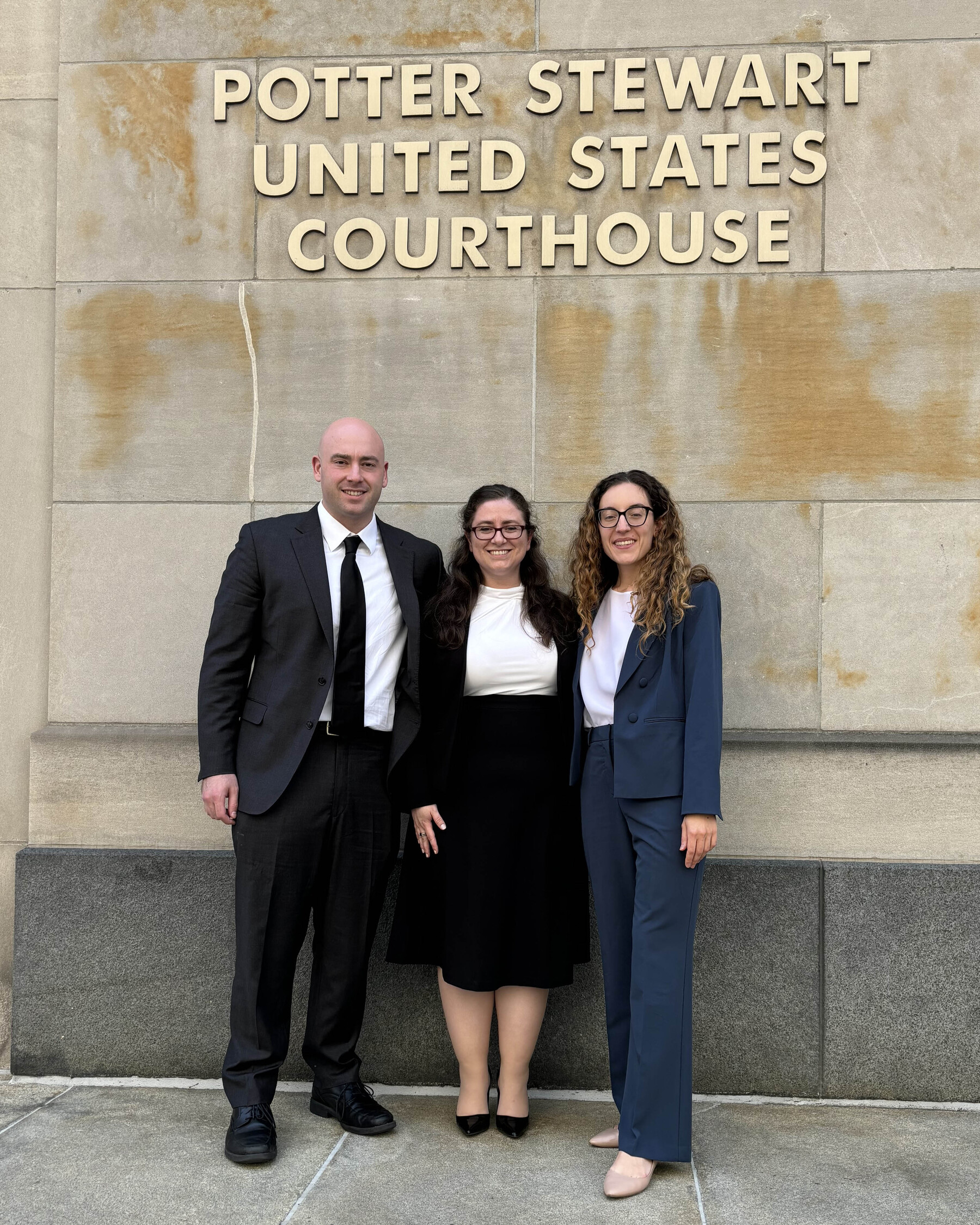
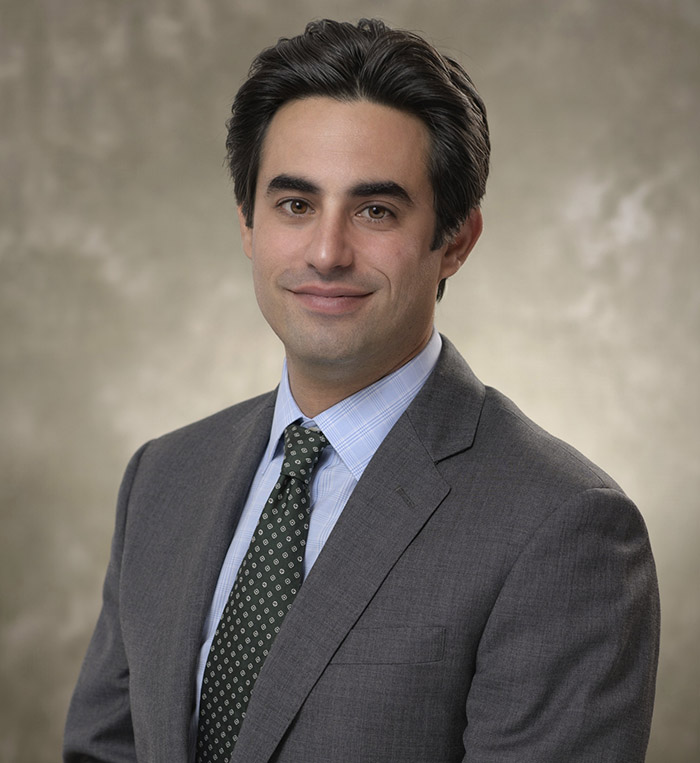
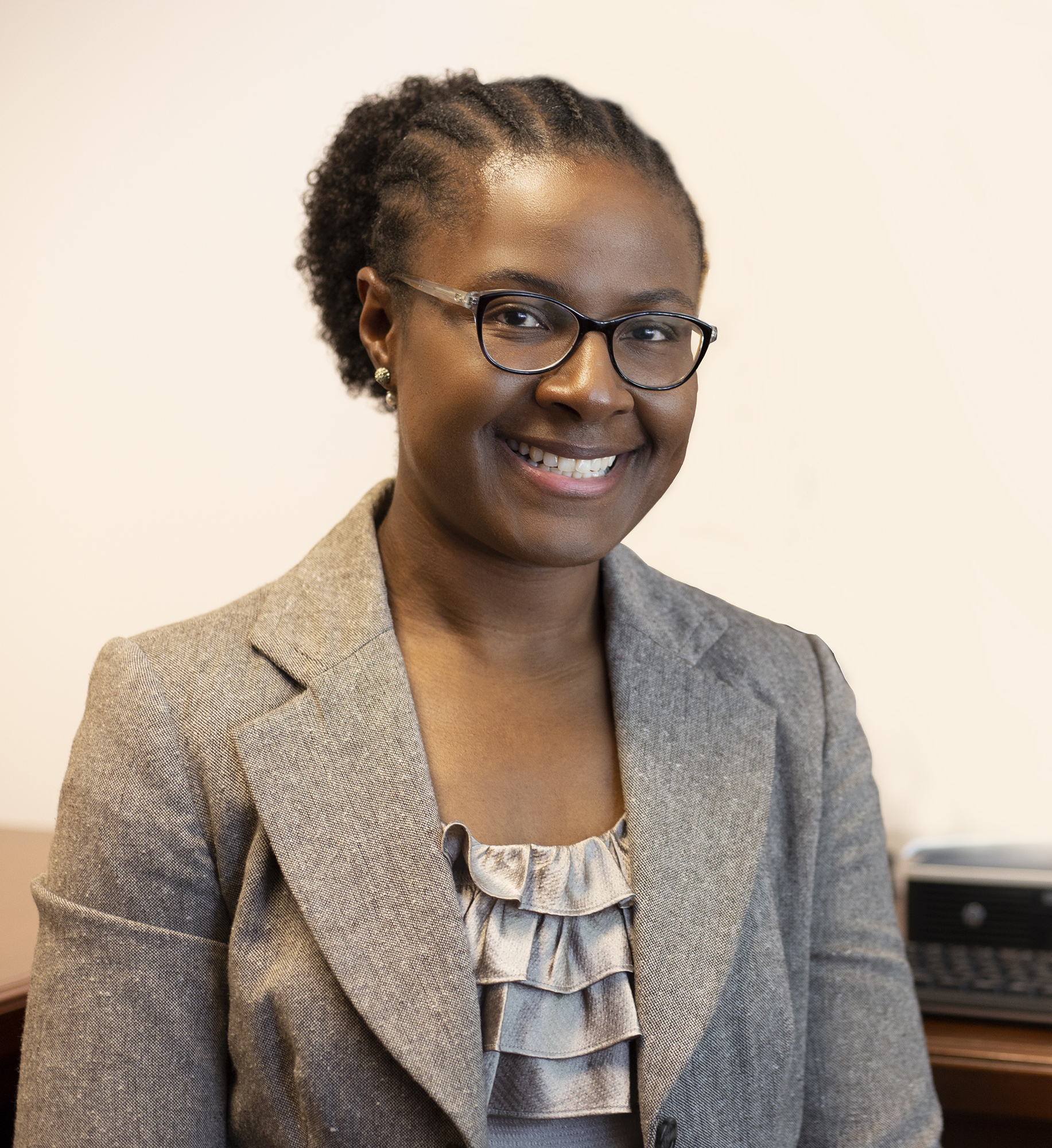
Tuesday, June 11, was about as perfect a day as you could ask for in Cincinnati, Ohio. There was barely a cloud in the sky and the mercury never surpassed 77 degrees. As First Amendment Clinic Director Lena Shapiro and clinicians Lilian Alexandrova ‘24 and Jonathan Resnick ‘24 approached the steps of the U.S. Court of Appeals for the Sixth Circuit, however, Resnick’s brow might have been a bit dewy.
“The night before and the morning of, I was incredibly stressed and nervous, like nothing I’ve ever felt in my life,” Resnick said with a laugh.
His nerves were understandable, of course, as he stood before the last appellate court before the Supreme Court, ready to take part in the first arguments presented by any First Amendment Clinic students.
He, Alexandrova, and Shapiro were appearing on behalf of a group of Libertarians whose members fell out of favor with the national party and were banned from using the national organization’s name and logo. The group had been restricted via an injunction from U.S. District Judge Judith E. Levy in August. It was at this point the Clinic got involved, helping appeal the decision to the Sixth Circuit in the case of Libertarian National Committee v. Saliba.
Alexandrova and Resnick were paired together for this case in fall 2023 and dove headlong into the work, finding inspiration in other classes and drawing upon their whole experience at the College of Law to create a strong argument for their clients. Close to the deadline for the brief, the clinicians, along with Shapiro and co-counsel, C. Nicholas Curcio of the Curcio Law Firm, went through an estimated eight or nine revisions over the course of several weeks, sacrificing free time and working late. The experience was nearly overwhelming, but the pair agreed it was among the most consequential aspects of their legal education.
“I honestly think it’s the most valuable thing I did in law school,” Alexandrova said.
“I think this type of experience is almost necessary,” Resnick agreed.
Brief writing was just a part of the experience, however, and the immensity of it did not scare the students away from signing up for another semester. To prepare for oral arguments in spring, College of Law professors put Alexandrova and Resnick through a litany of moot court sessions. With help from fellow students Christian Hallerud ’24 and Diana Sweeney ’24, the duo created arguments to present before the likes of Rummana Alam, Vikram Amar, Sean Anderson, Jim Fessler, Eric Johnson, Andrew Leipold, and Jason Mazzone. Despite the challenge—particularly from Amar and Mazzone, Resnick noted—the young attorneys felt much better prepared as a result.
“They were pretty intense. They didn’t hold back. They would interrupt you nonstop,” Alexandrova recounted. “I think that helped make me a better advocate for sure. I learned how to think on my feet a lot more than I ever have before. I personally, I have six years of mock trial experience, so I’m used to responding to evidentiary objections on the spot, but when it’s about the law and your entire argument, I think that’s a little bit harder.”
Although the anxiety was real as they entered the courtroom in June, their preparation and the presence of Shapiro at their side helped to settle their nerves. As the last case on the day’s schedule, the experience of watching other arguments—including arguments from University of Michigan law students—calmed them further.
When Libertarian National Committee v. Saliba was brought before the judges, Alexandrova delivered the argument while Resnick and Shapiro took notes and helped organize their rebuttal, which Resnick delivered. Their line of reasoning, that the case is fundamentally about the right to dissent and how not overturning or vacating the preliminary injunction would have a chilling effect on free speech, drew kind words from the judges hearing the case.
Shapiro had nothing but praise for her students as well.
“I’m extraordinarily proud,” she said. “They were very diligent. They took this very seriously, and they gave up time during their bar prep study in the summer to do this…. They worked great as a team. It was a pleasure to have them both semesters and into the summer. I would just really commend their hard work and their persistence to get better and advocate on behalf of our clients.”
Though they must wait on a decision, the experience itself has been something both clinicians reflected fondly upon as they studied for the bar and prepared for careers in litigation.
“When we were in the Sixth Circuit in Ohio, I felt like there was a reason we were doing this kind of work,” Alexandrova said. “And when you really think about it, if the Clinic didn’t take the case, I think effectively our clients would have been silenced. So, on a big-picture level, I think what we did was important.”