Robbennolt and interdisciplinary team introduce new ‘anomaly detector’ that flags outlier counties in police uses of lethal force

A new data-driven dashboard produced by the Cline Center for Advanced Social Research at the University of Illinois Urbana-Champaign uses predictive modeling to pinpoint U.S. counties that have unusually high or low numbers of police use of lethal force incidents relative to national benchmarks.

The Cline Center’s SPOTLITE project has compiled nearly a decade’s worth of data identifying police uses of lethal force across the U.S., making it the most comprehensive nationwide record available. It documents any law enforcement discharge of a firearm that risks human life, regardless of whether anyone was killed or injured, as well as any pursuit or other use of force that results in a civilian death.

SPOTLITE’s new “anomaly detector” feature will highlight parts of the country that may be in need of reform — or that might already be doing innovative things to reduce unnecessary uses of lethal force by police, said Scott Althaus, the Merriam Professor of Political Science at Illinois and the director of the Cline Center.

“SPOTLITE’s anomaly detector is the first national-scale resource for directing attention to counties with unusual numbers of lethal force incidents by police,” he said. “Up until now, there wasn’t a way to identify outliers, high or low, at a national scale. With the mountain of aggregated data our team has compiled through SPOTLITE, that’s enabled our researchers to do some modeling that can predict how many incidents we should expect to see in any given county.”

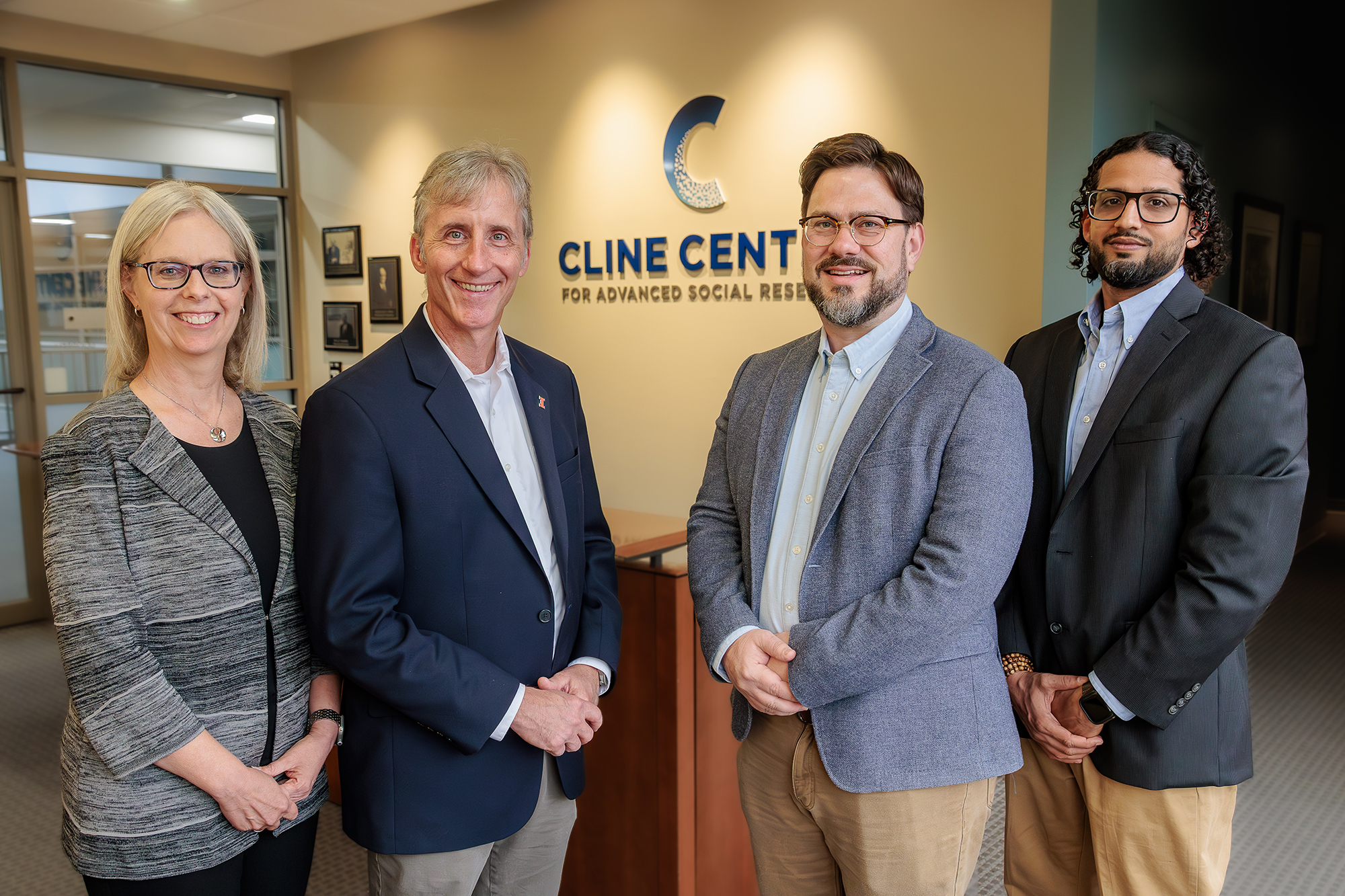
The interdisciplinary team of scholars and experts guiding the SPOTLITE project includes Althaus; Joseph Bajjalieh, a senior research manager at the Cline Center; Jay Jennings, the assistant director of research and a research scientist at the Cline Center; Michael Martin, a senior research coordinator at the Cline Center; Jennifer K. Robbennolt, the Alice Curtis Campbell Professor of Law at Illinois; Ajay Singh, the assistant director of strategic research initiatives and a research scientist at the Cline Center; and dozens of undergraduate and graduate student researchers who have worked since 2017 to compile the database.

Read the full story at news.illinois.edu.
Gerke named 2026-27 University Scholar

Sara Gerke is among five professors at the University of Illinois Urbana-Champaign that have been named 2026-2027 University Scholars in recognition of their achievements in teaching, scholarship and service. The program honors faculty excellence and provides $15,000 to each scholar for three years to enhance their academic careers. That money may be used for travel, equipment, research assistants, books or other purposes.

Gerke, the Richard W. and Marie L. Corman Scholar at the College of Law, is an expert in health law and bioethics with a particular focus on artificial intelligence and digital health. She also holds an affiliation as a professor in the European Union Center at Illinois.

Gerke’s research examines the ethical and legal challenges of AI and big data in healthcare as well as health law in the U.S. and Europe. She has led or contributed to numerous interdisciplinary projects that draw on her expertise in these fields, especially in emerging medical technologies such as artificial intelligence, robotics, bionics and stem cell research. Currently, Gerke is leading two major Illinois studies funded by the European Union through the Horizon Europe funding program: the legal and ethical implications of AI-assisted surgeries and the concerns raised by the use of AI in colonoscopies. With the explosion of interest in subject matters related to her research, Gerke’s work and perspective are in demand. She has more than 100 publications in her portfolio, is a frequent guest lecturer at institutions across the world and served as an external reviewer for the World Health Organization’s guidance on the “Ethics and Governance of Artificial Intelligence for Health.” 

Learn more about the other faculty members selected for this prestigious honor at news.illinois.edu.

Rowell publishes new interdisciplinary article on nuclear regulation

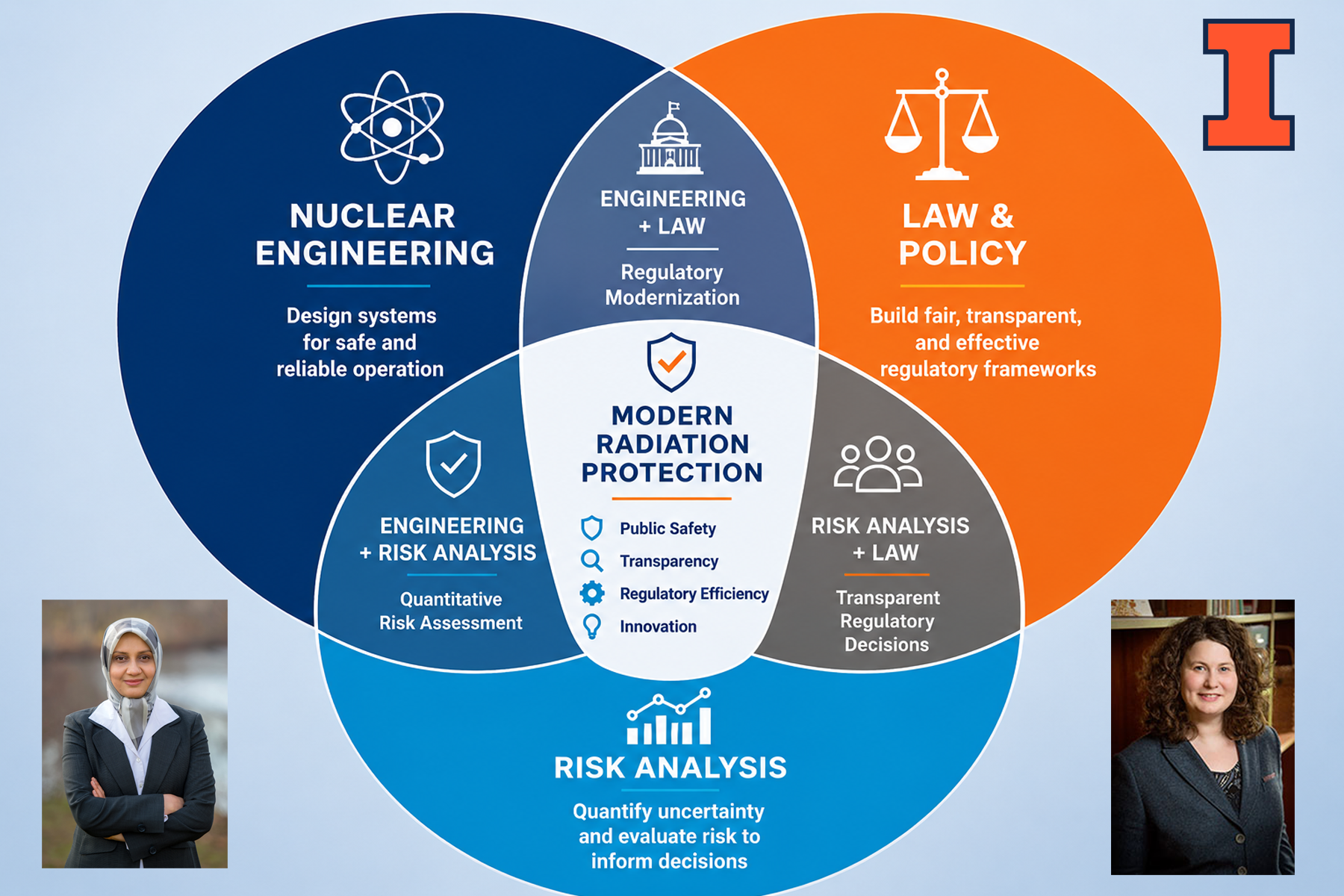
Professor Arden Rowell, in conjunction with researchers from the University of Illinois Grainger College of Engineering, recently published an article in Nuclear News proposing an interdisciplinary framework for modernizing one of the foundational principles of radiation protection. The U.S. Nuclear Regulatory Commission (NRC) recently released a proposed rule that would remove the long-standing As Low As Reasonably Achievable (ALARA) principle from its radiation protection regulations while retaining existing dose limits and opening the proposal for public comment, making their article, “Don’t Scrap ALARA—Modernize It,” especially timely.

Read more from NPRE.

SCOTUS made right decision in Hikma, Sherkow writes

In an new essay on Health Affairs, Professor Jacob Sherkow writes that the U.S. Supreme Court made the correct decision in Hikma Pharmaceuticals v. Amarin Pharma, giving generic drug manufacturers important protection against patent suits based on labeling approved by the Food and Drug Administration (FDA). This decision will “help preserve patient access to lower-cost medicines,” he writes; however, it also shifts pressure onto FDA, which does not interpret patent claims or decide whether future prescribing will infringe.

Read his full essay on Health Affairs.

Thomas speaks at NELA conference

In late June, Professor Suja Thomas was a featured speaker at the National Employment Lawyers Association conference in New Orleans, Louisiana. The theme of the conference was “Leading with Vision. Rooted in Justice.” and Professor Thomas spoke in one of the final sessions, covering “The Year in Review: Significant Developments in Employment Law.” Along with two other speakers, Thomas reviewed employment cases decided by the U.S. Supreme Court during its 2025–2026 term, as well as significant appellate court, legislative, and state law developments, and the emerging issues reshaping plaintiffs’ employment law practice.

Lawless joins American Bankruptcy Institute Podcast

The Supreme Court ruled in June on the case of Keathley v. Buddy Ayres Construction, unanimously held that courts should look to the totality of the circumstances when determining whether an omission of a claim in the bankruptcy context was inadvertent or mistaken for purposes of the judicial estoppel doctrine. Professor Robert Lawless, who joined an amicus brief on the case, joined host Bill Rochelle on the American Bankruptcy Institute Podcast to discuss the facts of the case, the decision, and how courts are likely to proceed moving forward.

Listen to the podcast.

Lawsky joins panel at New York Fed Innovation Conference

In June, Professor Sarah Lawsky joined a panel discussion on Turning Law into Verified Code at the Federal Reserve Bank of New York’s Innovation Conference. The two-day conference brought together individuals from academia, industry, and other areas to share ideas on technology and finance. The conference explored the landscape of the financial world and the role of banks and the private sector in innovation and stability.

Mazzone and Amar analyze new developments in judge suit

Following up on previous work, Professors Jason Mazzone and Vikram Amar continue their analysis of the federal lawsuit brought by Judge James R. Brown against the Justices of the Illinois Supreme Court in a new article at Justia Verdict. The court declined to issue a preliminary injunction, which the authors found defensible; however, much of the court’s reasoning was described as problematic in the article. They break down what aspects of the case they found most fault with at this point, but note that this will not be the end of the intrigue in this case.

Read their full article on Justia Verdict.

Rochelle’s Daily Wire quotes Lawless on copyright termination

Copyright termination is a process by which copyright holders may terminate a grant—or transfer—of their rights. In a recent Eleventh Circuit case, judges ruled that termination rights are retained by an estate even after discharge, a decision that presents some problems. Rochelle’s Daily Wire, a publication of the American Bankruptcy Institute, quoted Professor Robert Lawless on this topic, including his suggestion of how courts may create a more useful mechanism for future cases.

Read Rochelle’s Daily Wire.

Curtis examines lawfulness of Iran War

Can U.S. service members refuse to engage in what may be seen as unlawful orders? This is a question that has been at the forefront of many military news stories thanks to the FBI’s investigation into Sen. Mark Kelly and Sen. Lisa Murkowski, who reminded leaders of the legal option to refuse. Professor Yulanda Curtis, in an op-ed published by The Fulcrum, looks at the Iran War, which was not approved by Congress, and questions whether troops may be punished for disobeying orders even if the war is later determined to be illegal. “The United States faces a critical choice about the future of its military. Especially now when war has been initiated and U.S. troops have been killed,” she writes.

Read her full article on The Fulcrum.

College of Law
504 East Pennsylvania Avenue
Champaign, IL 61820
(217) 333-0931