First Amendment Clinic helps secure a victory against the Wisconsin DOJ, thanks in part to sustained efforts of student clinicians

On Tuesday, April 28, 2026, Dane County Circuit Court Judge Rhonda Lanford ruled that the Wisconsin Department of Justice must release its list of approximately 16,000 law enforcement officers currently certified in the state.  The judge rejected the DOJ’s arguments that releasing the list would identify undercover officers, subject officers to harassment, or put them in danger.

“When responding to records requests, there is a strong presumption of openness and liberal access to public records,” wrote the judge.  “[T]he DOJ has not met its burden to show that this is an ‘exceptional case’ warranting nondisclosure.”  The judge concluded that DOJ’s denial “was not the product of a genuine, case-by-case balancing analysis, but rather a habitual denial based on [its] past inability to garner compliance from local agencies.”

The suit was brought by The Badger Project and Invisible Institute.  The media organizations are represented by the Wisconsin Transparency Project and the University of Illinois College of Law First Amendment Clinic.

The Badger Project is a nonpartisan journalism nonprofit that focuses on and investigates government, politics, and related matters in Wisconsin. Invisible Institute is a nonprofit public accountability journalism organization based in Chicago.  Both organizations have litigated cases seeking police records and written extensively about law enforcement issues, particularly the problem of “wandering officers” who jump agencies to avoid discipline.

The Badger Project and Invisible Institute asked for officers’ names, birth years or ages, zip code, and work history.  Most states release this information, but have not experienced any significant problems caused by making the information public.  The request did not ask for home addresses.

Both organizations have reported on the lawsuit:

“Courts have ruled time and time again that speculative fears of harm do not justify withholding government records from the public,” said Tom Kamenick, president of the Wisconsin Transparency Project.  “Government officials must do more than merely claim that, hypothetically, something bad might happen if the records are released.  Rather, they must show that harm is likely to occur and is sufficiently serious to overcome the presumption of access to government records.  DOJ could not do that here.”

“We are incredibly proud to have represented the Invisible Institute in this critical fight for accountability,” said Lena Shapiro, Director of the First Amendment Clinic. “Securing this victory took three years of sustained effort, with nine students and two fellows from the First Amendment Clinic pouring their energy into this matter to ensure that the public’s right to know prevailed over blanket government secrecy.”

The Clinic students handled discovery, including resolving disputes and taking depositions, and briefed the successful motion for summary judgment, which was ultimately argued in January by advanced student Gabriela De La Llana.For a copy of the complaint, contact the First Amendment Clinic at the University of Illinois College of Law at law-firstamend@illinois.edu.

Criticism of medical journal by federal prosecutor is unconstitutional, Shapiro tells Law360

When Edward Martin Jr., the interim U.S. Attorney for the District of Columbia, chose to publish a letter criticizing the medical journal CHEST it raised a number of concerns. For free speech advocates, the most pressing concern was why a federal prosecutor would target the protected speech of an independent entity. Speaking to Law360, Professor Lena Shapiro, director of the First Amendment Clinic, said, “letter reads squarely as an attempt to engage in viewpoint discrimination against the journal, which is presumptively unconstitutional.”

Illinois LawCast: Understanding the TikTok ban with Lena Shapiro

The Supreme Court unanimously agreed the law banning TikTok from the United States was constitutional and should go into effect as written; however, on January 20th, President Donald Trump instructed the Attorney General not to enforce the law for 75 days. So, what is going on and what is the legal basis for any of it? Professor Lena Shapiro, who also leads our First Amendment Clinic Director, joined us for a bonus episode of the podcast to examine the details behind this case.

If you have comments or suggestions for the podcast, please contact podcast@law.illinois.edu.

First Amendment Clinic students present argument before the Sixth Circuit

Tuesday, June 11, was about as perfect a day as you could ask for in Cincinnati, Ohio. There was barely a cloud in the sky and the mercury never surpassed 77 degrees. As First Amendment Clinic Director Lena Shapiro and clinicians Lilian Alexandrova ‘24 and Jonathan Resnick ‘24 approached the steps of the U.S. Court of Appeals for the Sixth Circuit, however, Resnick’s brow might have been a bit dewy.

“The night before and the morning of, I was incredibly stressed and nervous, like nothing I’ve ever felt in my life,” Resnick said with a laugh.

His nerves were understandable, of course, as he stood before the last appellate court before the Supreme Court, ready to take part in the first arguments presented by any First Amendment Clinic students.

He, Alexandrova, and Shapiro were appearing on behalf of a group of Libertarians whose members fell out of favor with the national party and were banned from using the national organization’s name and logo. The group had been restricted via an injunction from U.S. District Judge Judith E. Levy in August. It was at this point the Clinic got involved, helping appeal the decision to the Sixth Circuit in the case of Libertarian National Committee v. Saliba.

Alexandrova and Resnick were paired together for this case in fall 2023 and dove headlong into the work, finding inspiration in other classes and drawing upon their whole experience at the College of Law to create a strong argument for their clients. Close to the deadline for the brief, the clinicians, along with Shapiro and co-counsel, C. Nicholas Curcio of the Curcio Law Firm, went through an estimated eight or nine revisions over the course of several weeks, sacrificing free time and working late. The experience was nearly overwhelming, but the pair agreed it was among the most consequential aspects of their legal education.

“I honestly think it’s the most valuable thing I did in law school,” Alexandrova said.

“I think this type of experience is almost necessary,” Resnick agreed.

Brief writing was just a part of the experience, however, and the immensity of it did not scare the students away from signing up for another semester. To prepare for oral arguments in spring, College of Law professors put Alexandrova and Resnick through a litany of moot court sessions. With help from fellow students Christian Hallerud ’24 and Diana Sweeney ’24, the duo created arguments to present before the likes of Rummana Alam, Vikram Amar, Sean Anderson, Jim Fessler, Eric Johnson, Andrew Leipold, and Jason Mazzone. Despite the challenge—particularly from Amar and Mazzone, Resnick noted—the young attorneys felt much better prepared as a result.

“They were pretty intense. They didn’t hold back. They would interrupt you nonstop,” Alexandrova recounted. “I think that helped make me a better advocate for sure. I learned how to think on my feet a lot more than I ever have before. I personally, I have six years of mock trial experience, so I’m used to responding to evidentiary objections on the spot, but when it’s about the law and your entire argument, I think that’s a little bit harder.”

Although the anxiety was real as they entered the courtroom in June, their preparation and the presence of Shapiro at their side helped to settle their nerves. As the last case on the day’s schedule, the experience of watching other arguments—including arguments from University of Michigan law students—calmed them further.

When Libertarian National Committee v. Saliba was brought before the judges, Alexandrova delivered the argument while Resnick and Shapiro took notes and helped organize their rebuttal, which Resnick delivered. Their line of reasoning, that the case is fundamentally about the right to dissent and how not overturning or vacating the preliminary injunction would have a chilling effect on free speech, drew kind words from the judges hearing the case.

Shapiro had nothing but praise for her students as well.

“I’m extraordinarily proud,” she said. “They were very diligent. They took this very seriously, and they gave up time during their bar prep study in the summer to do this…. They worked great as a team. It was a pleasure to have them both semesters and into the summer. I would just really commend their hard work and their persistence to get better and advocate on behalf of our clients.”

Though they must wait on a decision, the experience itself has been something both clinicians reflected fondly upon as they studied for the bar and prepared for careers in litigation.

“When we were in the Sixth Circuit in Ohio, I felt like there was a reason we were doing this kind of work,” Alexandrova said. “And when you really think about it, if the Clinic didn’t take the case, I think effectively our clients would have been silenced. So, on a big-picture level, I think what we did was important.”

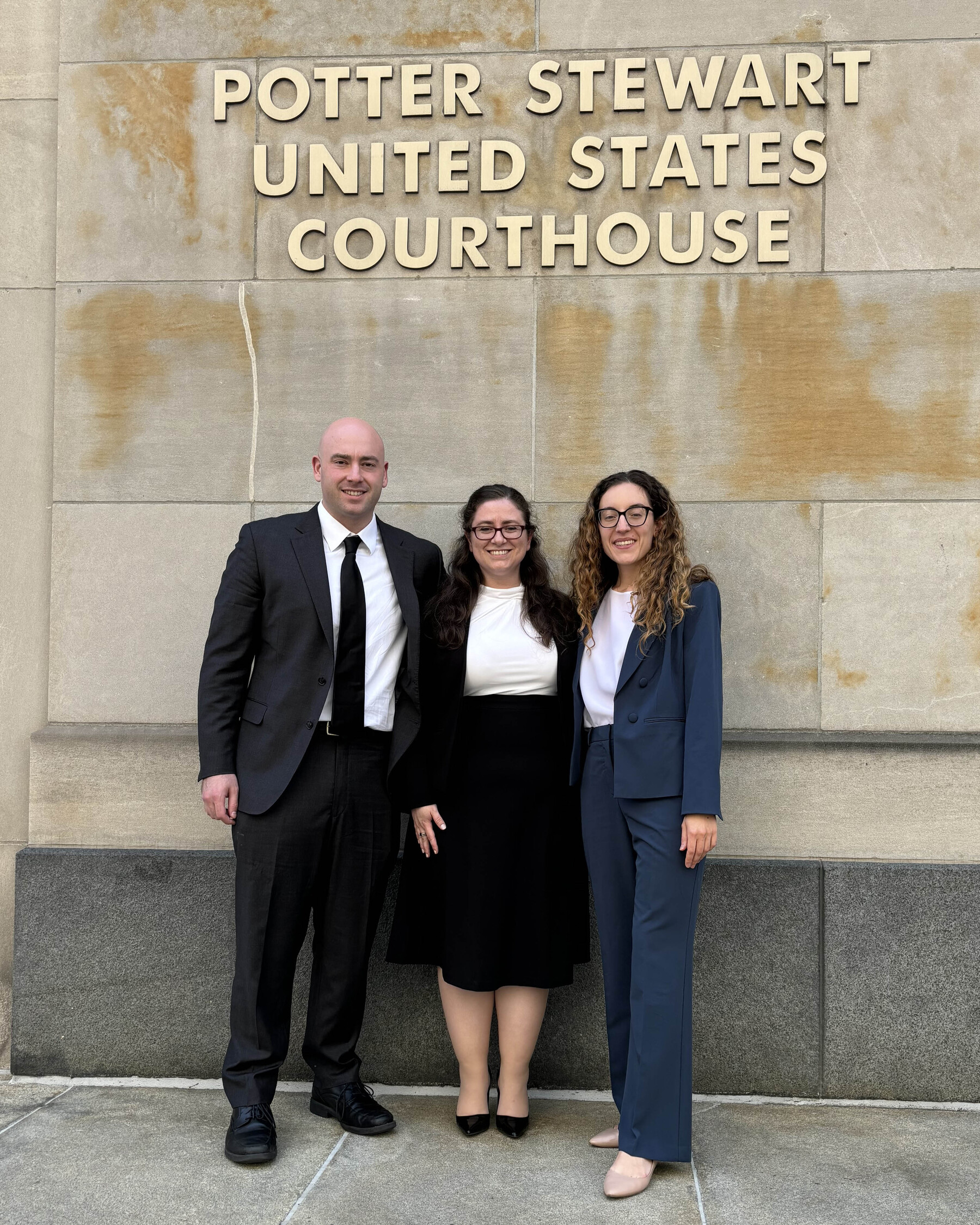
Jonathan Resnick, Director Lena Shapiro, and Lilian Alexandrova in front of the Sixth Circuit Courthouse in Cincinnati, Ohio.

Jonathan Resnick, Director Lena Shapiro, and Lilian Alexandrova in front of the Sixth Circuit Courthouse in Cincinnati, Ohio.

Delete

Edit embedded media in the Files Tab and re-insert as needed.

Shapiro speaks to CNN about campus protests

Speaking to CNN after pro-Palestinian demonstrators were removed from the campuses of Columbia and Brown, Lena Shapiro, director of the First Amendment Clinic, emphasized the importance of safety during campus demonstrations. She explained colleges should ensure all students have a space to protest while imposing reasonable restrictions on the time, place, and manner of protests to maintain order. Additionally, Shapiro highlighted the need for open communication between schools and protesters to find common ground and avoid conflicts.

First Amendment Clinic seeks Stanton Fellow for 2024-2025 academic year

The First Amendment Clinic is hiring a Fellow for the 2024-2025 academic year. This is a one-year position, with an anticipated start date between June 15, 2024, and August 19, 2024, with the possibility of renewal for a second year depending on performance and funding.

The University of Illinois College of Law launched the First Amendment Clinic in 2023 with the support of the Stanton Foundation. The Clinic works to defend and advance the rights of free speech, press, assembly and petition through litigation and advocacy, while providing law students with practice and real-world experience to become leaders on First Amendment issues.

The Clinic takes on a wide array of matters including defending individuals exercising their right to dissenting political speech, advancing litigation on behalf of journalists to gain access to vital information, pursuing claims arising out of retaliation for First Amendment-protected speech, and advocating for the rights of citizens to openly critique government entities and officials. The Clinic represents individuals and organizations across the Midwest whose viewpoints span the political spectrum.

Amar, Mazzone, and Shapiro author article on Disney’s speech-retaliation case

In early 2024, a federal district court judge dismissed a lawsuit filed by the Disney Corporation against Florida officials for alleged retaliation against Disney’s opposition to certain Florida laws and policies by altering the board that regulates the land where Disney World is located. Professors Vikram Amar, Jason Mazzone, and Lena Shapiro collaborated in an article for Justia Verdict examining the complex constitutional issues raised by this decision. “If government is trying to retaliate against you because of your past speech, doesn’t that violate your First Amendment rights regardless of whether the retaliation takes the form of speech regulation itself?” the professors wrote.

Shapiro talks campus free speech with Illinois News Bureau

When it comes to speech, “There is legal freedom and there is practical freedom,” Professor Lena Shapiro explained. The director of the First Amendment Clinic explained how the freedoms related to speech in the United States are applied on college campuses, especially in the wake of the October 7 attacks in Israel and the ensuing war. “Most expressions commonly identified as “’hate speech’ are protected by the First Amendment and cannot lawfully be censored, punished or unduly burdened by the government – including by public colleges and universities,” she said.

Law360 quotes Shapiro on dissent in political contexts

Does the Lanham Act, which provides the national system of trademark registration and protects owners of registered marks against the use of similar marks, allow national political parties to prohibit individuals from using of their name and logo in communications? This is the key question in a case before the U.S. Court of Appeals for the Sixth Circuit, in which the Libertarian National Committee is seeking to stop the Libertarian Party of Michigan from using its marks. The Libertarian Party of Michigan claims their use of the mark for political activities falls outside the Lanham Act’s protections designed for unauthorized use of trademarks in commerce. Professor Lena Shapiro, acting as counsel for the Libertarian Party of Michigan, stressed to Law360 the importance of protecting essential political activities and hopes the Sixth Circuit will rule that political activities should be excluded from trademark infringement law.

Shapiro discusses Kansas newspaper raid with Illinois News Bureau

In a dramatic scene, police in Marion, Kansas, raided the offices of the Marion County Record newspaper in late August, seizing reporters’ cell phones and computers, among other items. The “unheard of” raid immediately raised questions of First Amendment protections afforded to newspapers like the Marion County Record, which is owned by former Illinois journalism professor Eric K. Meyer. To address these questions, the Illinois News Bureau interviewed Professor Lena Shapiro, director of the First Amendment Clinic, who was unequivocal in her assertion that the raid was a violation of the Constitution’s protections. “This raid should never have happened in the first place, and I hope that the embarrassing outcome for Marion County in the government officials’ pursuit of the raid serves as a deterrent to others who want to push aside First Amendment protections to retaliate against journalists,” she said.

College of Law
504 East Pennsylvania Avenue
Champaign, IL 61820
(217) 333-0931