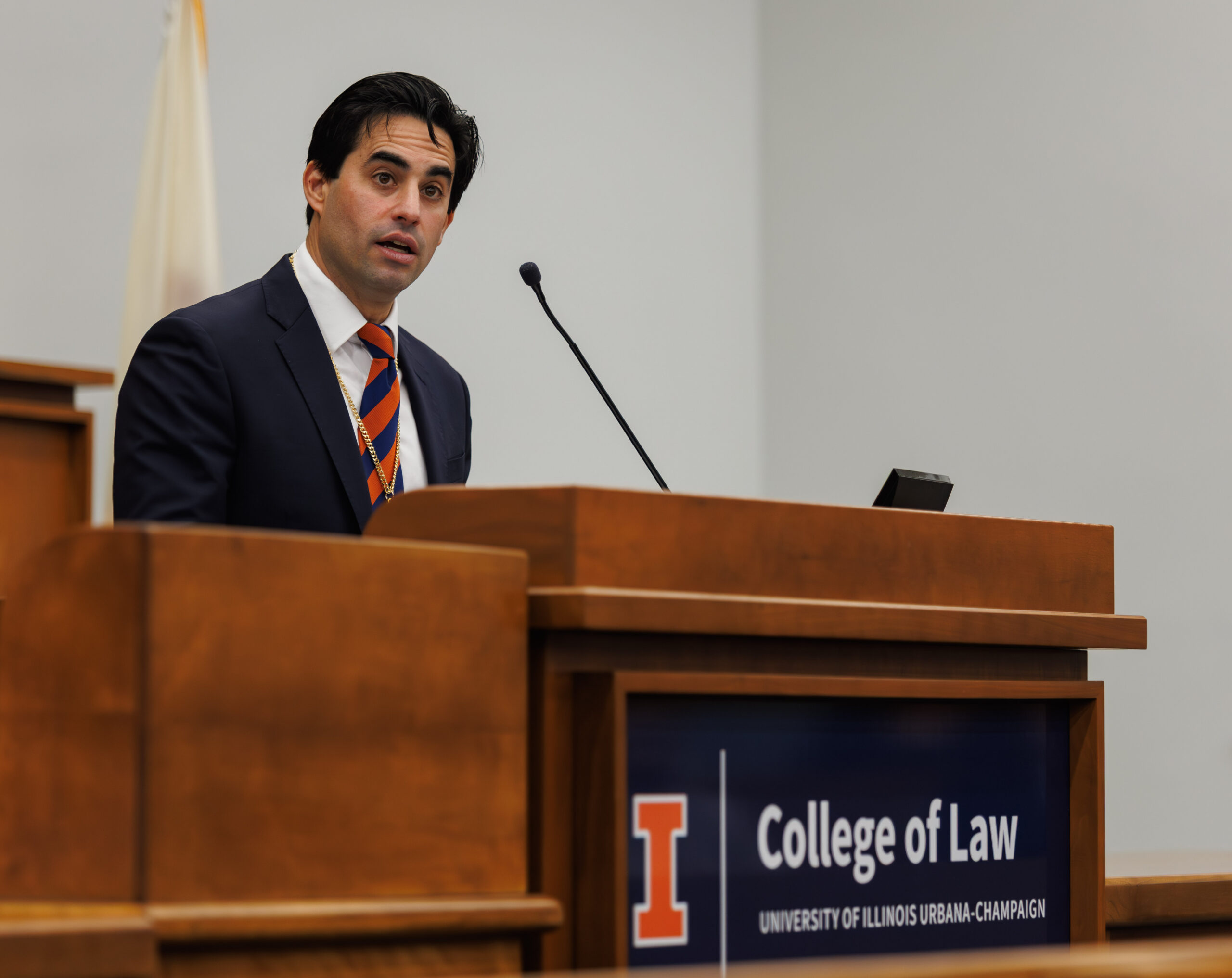
Illinois LawCast: First-Year Experiences

The first year of law school is a unique experience. Though some students may have the option to enroll in pre-law minor, there is no requirement for any specific curriculum to be admitted to law school, which makes the first year a foundational year that can be challenging, surprising, and inspiring in a short period of time. For this episode, we gathered a few talented and intelligent members of the Illinois Law Class of 2028 to discuss their 1L year as it comes to an end. Guests in this episode are Blessing Agyare, Liam Davis, and Darius Johnson, who discussed why they chose to study law at Illinois, what surprised them about their first year, what they’ll take with them as they go forward, and more.

If you’d like to know more about student life at Illinois Law, please check out our website. If you are considering applying, our application is always free—no codes required.

If you have comments or suggestions for the podcast, please contact podcast@law.illinois.edu.

Clinic students earn dismissal of some charges for client

For young lawyers, a first appearance in court is a big deal. Standing before a judge and presenting hours of hard work can reaffirm hopes and dreams or it can alter career trajectories; either way, it is not easily forgotten.

For third-year students Henry Lu and Joseph Saoud, taking part in the First Amendment Clinic offered that chance to get courtroom experience and much more.

“I personally really wanted to get that hands-on experience. I was told before starting that clinic gives students the opportunity to kind of lead their own cases, something that a lot of junior associates won’t be able to get,” Lu said. “We were given that opportunity. We had pretty significant leeway in terms of being able to navigate through the case, and I think that that was a really valuable experience.”

Lu and Saoud were assigned a defamation case involving rival politicians. After their political campaign against each other, one of the politicians filed suit claiming statements from the other politician were defamatory. The First Amendment Clinic pair joined the case in the early stages and worked on a motion to dismiss some or all of the claims as not defamatory as a matter of law.

Both students came to the clinic with a passion for the First Amendment and were excited to tackle a case like this, putting what they’ve studied so diligently in class to practice in a real-life setting. At times the case felt imposing, between the weight of filing documents in court for the first time and working for older professionals while still a student. Saoud described it as a “different kind of pressure.”

“There’s something about the stakes being so much higher when you know that this is a consequential piece of paper I’m working on right now and if I don’t give it my all this can have really big implications for someone’s life,” he added. “I think that pushed us to produce our best work when maybe in class we would have been just tired and not wanting to put in more work. But it was great. I feel so much more confident now.”

After their day in court, Lu and Saoud were able to get four-and-a-half of the 12 statements in the suit dismissed for their client, a result both felt proud to have accomplished. Saoud summed it up by saying, “If success is all the learning that we did, absolutely it was successful.”

Though helping their client was the most important thing, Lu and Saoud agreed the work was important for them personally. The experience writing briefs and learning administrative parts of the job, such as tracking hours, will be greatly beneficial in the very near future after the duo graduate and begin their careers. For all those reasons, the First Amendment clinic experience is one they would recommend to any student.

“I think the First Amendment Clinic was one of the most valuable experiences of my law school journey,” Lu said. “You spend so much time in the classroom in law school, and you never actually get to participate in the practice of law, which is what you go to law school for in the first place. Joseph and I talked about this a lot, but we always recommend our friends to apply for the First Amendment Clinic and we tell them about our experience. I think a lot of people would definitely benefit from it.”

Learn more about the First Amendment Clinic at Illinois.

Gerke: Autonomous AI-based drug prescribing rife with potential problems

A first-of-its-kind pilot program in Utah developed by a health-technology startup company uses artificial intelligence to automatically renew certain prescriptions for patients with chronic conditions such as hypertension and diabetes. But according to a new paper co-written by a University of Illinois Urbana-Champaign expert in legal issues surrounding cutting-edge medical technology, autonomous AI-based drug prescribing raises important clinical and legal issues.

With AI rapidly being deployed in health care, a “move fast and break things” mentality has permeated the industry, raising complex questions about the role of the U.S. Food and Drug Administration in regulating these technologies, says Sara Gerke, the Richard W. & Marie L. Corman Scholar at the College of Law.

“The big issue here is the relationship between state and federal law, which we’re seeing in Utah, where the state has become a testing ground for so-called AI sandboxes that companies can use to experiment,” said Gerke, also a professor at the European Union Center at Illinois. “The idea behind it is to test these AI medical tools before they are completely developed. But even that is legally questionable. The existence of mitigation agreements and waivers under state law doesn’t automatically render the use of unproven medical technology lawful at the federal level.”

Immigration Law Clinic selected by ISBA for the 2026 John E. Thies Excellence in Legal Education Award

The Illinois State Bar Association (ISBA) has named the University of Illinois College of Law Immigration Law Clinic as one of the recipients of the 2026 John E. Thies Excellence in Legal Education Award. The award recognizes law school programs that emphasize real world skills for law students. The clinic will be honored at the ISBA Member Appreciation and Recognition Reception on Thursday, May 14 at the Morton Arboretum.

Kaplan says Trump’s recent remarks about pulling back on federal funding of Medicare are result of “fundamental misunderstanding” of how the program works

According to the New York Sun, President Trump suggested during remarks at a private luncheon that the federal government may no longer support essential care programs and that states should instead rely on state-level funding to do so.

Professor and tax law expert Richard Kaplan says that the president’s remarks about Medicare, in particular, rest on a fundamental misunderstanding of how the program is financed.

“Medicare is almost entirely funded by the federal government through payroll taxes paid by almost all employees, the great majority of self-employed persons, and most employers; premiums paid by program enrollees; and general federal funds,” Kaplan said. “States have no role of any consequence.”

First Amendment Clinic helps secure a victory against the Wisconsin DOJ, thanks in part to sustained efforts of student clinicians

On Tuesday, April 28, 2026, Dane County Circuit Court Judge Rhonda Lanford ruled that the Wisconsin Department of Justice must release its list of approximately 16,000 law enforcement officers currently certified in the state.  The judge rejected the DOJ’s arguments that releasing the list would identify undercover officers, subject officers to harassment, or put them in danger.

“When responding to records requests, there is a strong presumption of openness and liberal access to public records,” wrote the judge.  “[T]he DOJ has not met its burden to show that this is an ‘exceptional case’ warranting nondisclosure.”  The judge concluded that DOJ’s denial “was not the product of a genuine, case-by-case balancing analysis, but rather a habitual denial based on [its] past inability to garner compliance from local agencies.”

The suit was brought by The Badger Project and Invisible Institute.  The media organizations are represented by the Wisconsin Transparency Project and the University of Illinois College of Law First Amendment Clinic.

The Badger Project is a nonpartisan journalism nonprofit that focuses on and investigates government, politics, and related matters in Wisconsin. Invisible Institute is a nonprofit public accountability journalism organization based in Chicago.  Both organizations have litigated cases seeking police records and written extensively about law enforcement issues, particularly the problem of “wandering officers” who jump agencies to avoid discipline.

The Badger Project and Invisible Institute asked for officers’ names, birth years or ages, zip code, and work history.  Most states release this information, but have not experienced any significant problems caused by making the information public.  The request did not ask for home addresses.

Both organizations have reported on the lawsuit:

“Courts have ruled time and time again that speculative fears of harm do not justify withholding government records from the public,” said Tom Kamenick, president of the Wisconsin Transparency Project.  “Government officials must do more than merely claim that, hypothetically, something bad might happen if the records are released.  Rather, they must show that harm is likely to occur and is sufficiently serious to overcome the presumption of access to government records.  DOJ could not do that here.”

“We are incredibly proud to have represented the Invisible Institute in this critical fight for accountability,” said Lena Shapiro, Director of the First Amendment Clinic. “Securing this victory took three years of sustained effort, with nine students and two fellows from the First Amendment Clinic pouring their energy into this matter to ensure that the public’s right to know prevailed over blanket government secrecy.”

The Clinic students handled discovery, including resolving disputes and taking depositions, and briefed the successful motion for summary judgment, which was ultimately argued in January by advanced student Gabriela De La Llana.For a copy of the complaint, contact the First Amendment Clinic at the University of Illinois College of Law at law-firstamend@illinois.edu.

Lawless quoted in Bloomberg on arbitration’s rising role in bankruptcy disputes

As consumer bankruptcy filings continue to rise, the role of arbitration has also increased. Because the Federal Arbitration Act and the US bankruptcy code can be at odds with each other and that tension has not yet been tested by the Supreme Court, experts expect that the matter will eventually make its way there.

Professor and bankruptcy expert Bob Lawless, who has written a paper on arbitration and bankruptcy, says that unless amended or repealed, courts should follow both statutes.

Speaking to Bloomberg, he said, “You’ve got to look and say, ‘For this matter in this arbitration agreement, is this subject to arbitration, and does the arbitral demand conflict with a command in the bankruptcy code?’”

College of Law
504 East Pennsylvania Avenue
Champaign, IL 61820
(217) 333-0931