Illinois Law remembers Dave Downey ’66

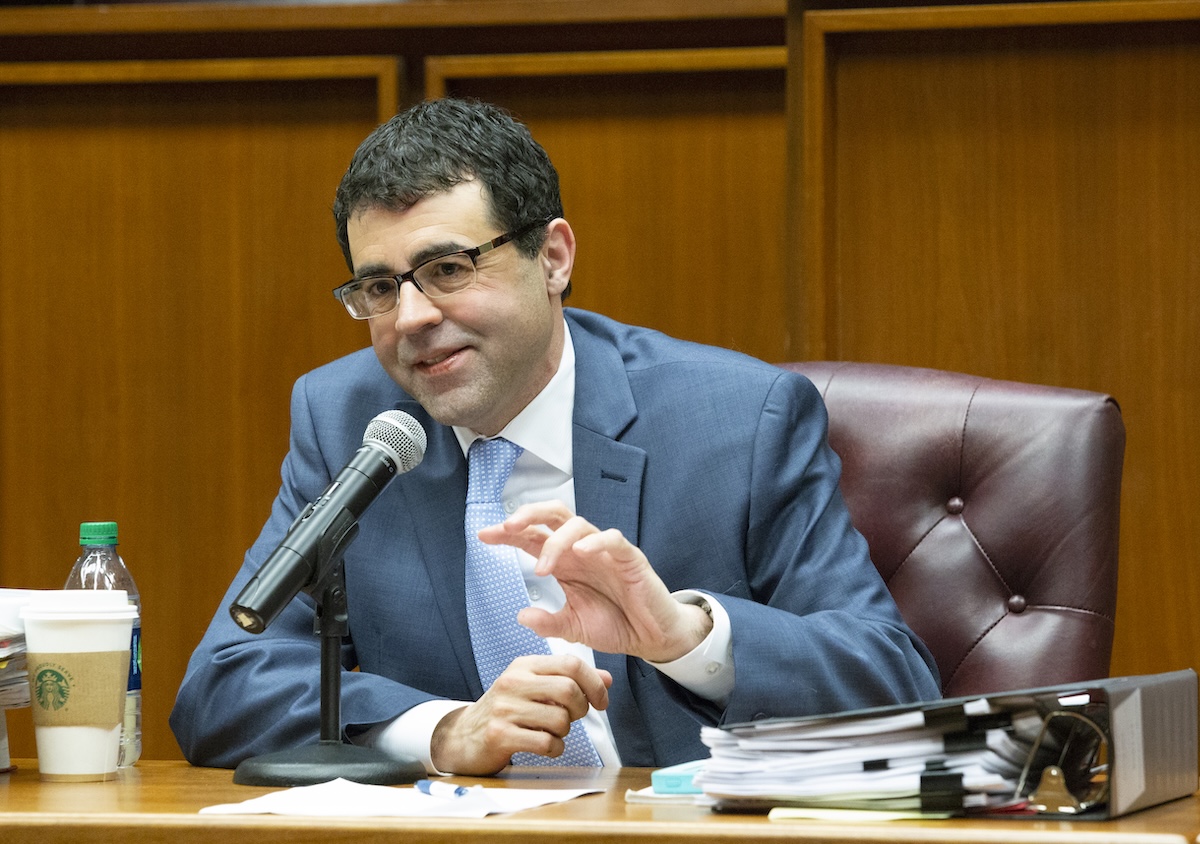
Very few individuals can claim honors like those Dave Downey earned: the basketball court at Canton High School was recently renamed in his honor; he still holds the single-game scoring record at the University of Illinois, and State Farm Center has a “Club 53” commemorating his 53-point performance; and in his professional career, he was named Mass Mutual Man of the Year twice before turning 40 years old. Downey passed away at age 84 on December 27, 2025, but his life and legacy live on.

Among the many outstanding facts about his life, Downey may be the only person who chose to attend law school rather than play in the NBA. He never played a game for the San Francisco Warriors, who drafted him in 1963, but he did graduate from the College of Law in 1966, and his law degree remained a point of pride throughout his life according to his wife, Jane Hays ’79. 

“Dave was truly one of a kind,” Hays said. “He was proud of his law degree from Illinois, and forever grateful for the education, friendship, patience, and forbearance of his professors and classmates.”

Coming from humble beginnings did not stop Downey from dreaming big. He made it to college on a basketball scholarship and worked part time to help make ends meet. He kept his job selling insurance as a law student, but despite employment was unable to pay for the needs of his growing family and buy all the books he needed. Though this frustrated some professors, his prodigious memory and the aid of study groups helped earn admittance to the Illinois bar.

Downey chose not to pursue a legal career, opting instead to continue with Mass Mutual and using his degree to advocate for the insurance industry in Washington, D.C., and helping organize the Advanced Association of Life Underwriters.

“He told people, self-effacingly, that he didn’t think of himself as a ‘real lawyer,’” Hays said. “Nevertheless, he knew his law degree and bar admission were vitally important to his successful career in advanced life insurance.”

Outside of professional life, Downey was committed to serving the community. He served on the University of Illinois Board of Trustees, the University of Illinois Foundation Board, the University of Illinois Athletic Board, and the Illinois Board of Higher Education, among other endeavors. He and Hays have also provided generous philanthropic support to almost every academic unit on campus, most recently endowing the Phyllis M. Wise Endowed Professor in Medicine and Innovation at the Carle Illinois College of Medicine.

For his professional and philanthropic efforts, Downey received the Distinguished Alumni Award from the College of Law in 1984. His blazer may not hang in the rafters of the Law Building the way his jersey hangs in State Farm Center, but he will not be forgotten. The College of Law sends its condolences to all of Downey’s family and friends.

Illinois LawCast: Undergraduate Opportunities with Jennie Pahre and Meghan Brinson

Learning the law isn’t solely the province of graduate students. The University of Illinois offers undergraduates the chance to enroll in the Legal Studies minor for those interested in pursuing a JD after graduating or those who would just like to broaden their understanding of the law within their field. The Legal Studies minor is a novel program because of its tracks, where students can choose to focus on law & politics, law & cultures, or law & economics of food security and sustainability. In this episode, Professors Jennie Pahre, director of undergraduate studies, and Meghan Brinson, associate director of undergraduate studies and academic advisor for undergraduate studies, share their expertise on the Legal Studies minor, why they enjoy working with undergrads, and ideas for the future of the program.

Professor Jennifer Pahre joined the College of Law in 2001. She oversaw the Legal Externship Program for 15 years before became the director of undergraduate studies. She earned her bachelor’s degree from Stanford University and JD degree from Loyola Law School of Los Angeles. Professor Pahre is admitted to the state bars of California, Michigan, and Illinois and has practiced law in all three states as well as several district courts. She served on the Insurance Coverage Litigation Committee of the American Bar Association and she has served as the president of the East Central Illinois Women Attorneys Association.

Professor Meghan Brinson earned her JD at University of North Carolina School of Law, and holds a Master of Arts in English Studies from Georgetown University and a Master of Fine Arts in Creative Writing from Arizona State University. She has experience teaching undergraduate composition, business writing, and creative writing, including as a Piper International Writing Fellow at the National University of Singapore and with Park University’s program on Marine Corp Air Station Cherry Point. Professor Brinson is a poet and nonfiction essayist with three published chapbooks and several journal publications.

If you have comments or suggestions for the podcast, please contact podcast@law.illinois.edu.

Mercury News quotes Sherkow on California’s generic insulin

To help residents with the high cost of insulin, a necessary drug for patients with diabetes, the state of California decided to develop its own generic brand of the medicine. The project will begin distributing “CalRx” insulin to consumers in January, and the San Jose Mercury News spoke to Professor Jacob Sherkow about how this plan is affecting insulin more broadly. The plan, he explained, is putting “downward pressure” on prices across the market.

Harlem World quotes Leipold on grand juries

Grand juries have twice declined to re-indict New York Attorney General Letitia James for mortgage fraud, despite the Trump administration’s efforts. The decisions are a strong rebuke of the administration, and Harlem World quoted Professor Andrew Leipold in their article on the subject, noting “something has gone horribly wrong” in the case when a prosecutor fails to secure an indictment.

Illinois LawCast: Student Services with Dean of Students Kelly Salefski

In this episode, we speak with Kelly Salefski, who was named Assistant Dean of Academic Administration and Dean of Students in June. She shared a great deal about what the College of Law is doing to help students achieve their goals, as well as her plans to improve our services and how her background helps her to do great things for our students.

Few individuals are as dedicated to Illinois as Salefski. A double Illini, graduating with an undergraduate degree in integrative biology in 2002 and JD in 2005, she began her career at the College of Law right after taking the bar exam, serving initially as Assistant Director of Academic and Student Administration. Over the past twenty years, Kelly has continued her work with students, leading to her most recent position as Senior Director of Academic Administration and Student Records.

Known to students for her work in academic counseling and an always friendly presence in the Law Building, Salefski has a strong commitment to helping make Illinois more than just a place to earn a degree and is eager to foster success in the student body. Evident by her tenure at the College of Law, Kelly has deep affection for the University of Illinois and the surrounding community, where she has proudly raised her family.

If you have comments or suggestions for the podcast, please contact podcast@law.illinois.edu.

Rowell co-authors editorial on nuclear regulation

Many recent changes in rules and regulations surrounding nuclear power reactors have been enacted with the goal of expanding the use of nuclear technology, but the shifts also run the risk of overwhelming the Nuclear Regulatory Commission and threatening the industry. In a new editorial published by Nuclear Newswire, Professor Arden Rowell and a team of nuclear engineers from the University of Illinois attempt to answer urgent questions in order “to prevent industry-wide paralysis and ensure that new nuclear power reactors are deployed both safely and efficiently.”

Watson publishes new article in Boston University Law Review

What is really being debated when individuals debate legal interpretation? This is the central question in a new paper written by Professor Bill Watson published in the latest issue of the Boston University Law Review. The “meta-interpretive” question “is key to making progress,” according to Watson. “We should be wary of monolithic interpretive theories that purport to apply across the board,” he concludes.

Bivens Act a good start, but imperfect argue Mazzone and Amar

In October, the Illinois Legislature passed the Bivens Act, which provides new state-level protections for individuals interacting with Illinois courts, hospitals, schools, and child-care centers during civil immigration enforcement activities. Writing at Justia Verdict, Professors Jason Mazzone and Vikram Amar praise the law as “an important and innovative law in keeping with the proudest tradition of federalism”; however, they note that some aspects of the Act are unlikely to survive federal constitutional challenges. In their article, they explain why the law is good and why some parts are destined to be struck down.

Brinson joins IICLE podcast to talk literature and law

In addition to her JD from the University of North Carolina, Meghan Brinson also holds an MFA in creative writing from Arizona State University, which made her an ideal guest for the Cornered podcast’s episode on literature and the law. Speaking on the show, produced by the Illinois Institute for Continuing Legal Education, Brinson discussed her background, her law and literature course, and how she combines her interests for the benefit of her students.

New paper from Sherkow: “Intellectual Property, New Genomic Technologies And Plant Innovation: Clearing Innovation Pathways”

Professor Jacob Sherkow has co-authored a new paper with Laura Valtere (University of Copenhagen – CeBIL) and Timo Minssen (University of Copenhagen – CeBIL) titled “Intellectual Property, New Genomic Technologies And Plant Innovation: Clearing Innovation Pathways.” The abstract follows:

New genomic technologies (NGTs), such as genome editing-the modification of DNA in living cells-promises to revolutionize agriculture. Beyond simply yielding new, commercially viable crop varieties, NGTs also hold out promise of using novel crops as a “biosolution”-methods to improve sustainability practices by reducing pesticide usage, improving drought tolerance, increasing yield, and minimizing food and fertilizer waste. At the same time, the complex global system of intellectual property (IP) protection for crops has largely been unchanged for decades. There is accordingly some concern that the current crop IP system will not bring the promise of agricultural biosolutions to fruition. This Article reviews NGTs as biosolution and explores how they fit into the current international IP system for crops. Against this backdrop, this Article also reviews several current proposals to crop IP regime, before tentatively suggesting recommendations for rebalancing the incentive structures in crop IP.

College of Law
504 East Pennsylvania Avenue
Champaign, IL 61820
(217) 333-0931