First Amendment Clinic students sworn in to federal court

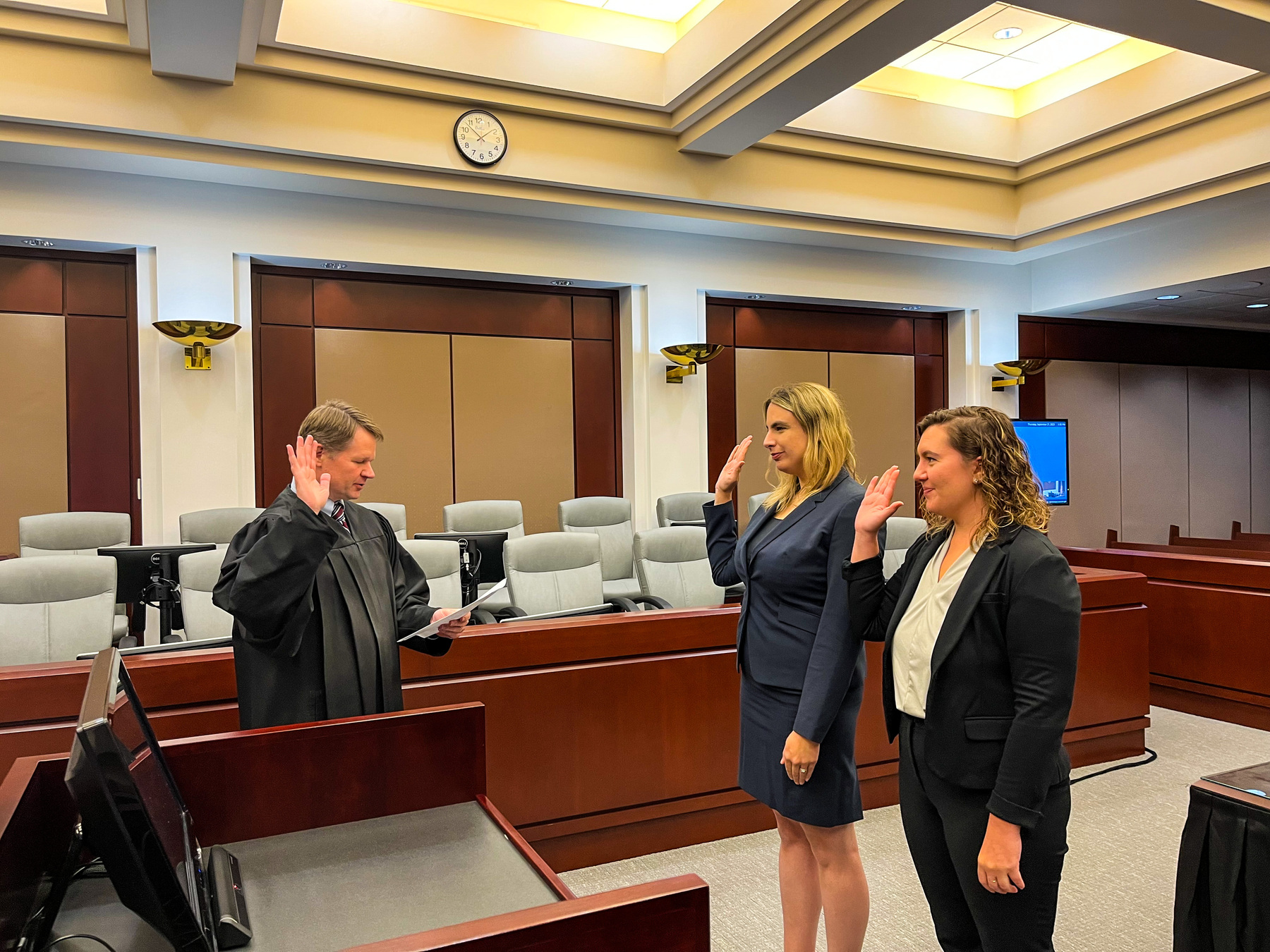
On September 21, 2023, College of Law students Trisha A. Makley and Natasha E. Spann were sworn in by the Honorable Eric I. Long, United States Magistrate Judge for the Central District of Illinois, at the U.S. Federal Courthouse in Urbana.

Under the supervision of the University of Illinois College of Law First Amendment Clinic Director Lena Shapiro, Makley and Spann will represent a previously pro se litigant in a federal civil rights trial centered on a First Amendment issue in the Central District of Illinois. Though working under the supervision of an experienced attorney, the students will be responsible for all aspects of the legal representation of their client. 

Judge Eric I. Long swears in First Amendment Clinic students Natasha E. Spann and Trisha A. Makley.

Judge Eric I. Long (left) swears in First Amendment Clinic students (L to R) Natasha E. Spann and Trisha A. Makley.

Delete

Edit embedded media in the Files Tab and re-insert as needed.

Shapiro discusses Kansas newspaper raid with Illinois News Bureau

In a dramatic scene, police in Marion, Kansas, raided the offices of the Marion County Record newspaper in late August, seizing reporters’ cell phones and computers, among other items. The “unheard of” raid immediately raised questions of First Amendment protections afforded to newspapers like the Marion County Record, which is owned by former Illinois journalism professor Eric K. Meyer. To address these questions, the Illinois News Bureau interviewed Professor Lena Shapiro, director of the First Amendment Clinic, who was unequivocal in her assertion that the raid was a violation of the Constitution’s protections. “This raid should never have happened in the first place, and I hope that the embarrassing outcome for Marion County in the government officials’ pursuit of the raid serves as a deterrent to others who want to push aside First Amendment protections to retaliate against journalists,” she said.

Block Club cites Shapiro on legal issues of anti-abortion protests

Chicago’s “bubble ordinance” is meant to protect patients from harassment or unwanted solicitation any time they are within a 50-foot radius from the entrance of a medical facility. Protesters’ escalating behavior, particularly in front of facilities that provide abortion services, has led Ald. Bill Conway (34th) to propose a quiet zone in these areas. Professor Lena Shapiro, director of the First Amendment Clinic, spoke to Block Club about this issue and the balance necessary to maintain the right to protest with protections for patients.

Shapiro discusses removing social media posts on WGN

“The internet never forgets” is a popular saying used as a way to warn individuals against sharing too much information on social media. However, when something is removed from social media, is it a violation of an individual’s First Amendment rights? Director of the First Amendment Clinic, Professor Lena Shapiro, joined WGN’s “Let’s Get Legal” to discuss this, the Biden administration and public platforms, and more.

303 Creative decision upholds power of the First Amendment, Shapiro writes

Commenting on the Supreme Court case 303 Creative LLC v. Elenis, Professor Lena Shapiro writes that the decision is an “unexpected champion for First Amendment liberties.” Her opinion article, written for the Student Press Law Center, pushes back against the narrative that the decision—in which the Court sided with a website designer who refused to create websites for same-sex couples, citing religious convictions—will allow individuals a license to discriminate. To the contrary, she writes, the decision is “about the freedom not to speak when the message doesn’t resonate with one’s beliefs.”

First Amendment Clinic joins amicus brief in O’Connor-Radcliff v. Garnier

The First Amendment Clinic, led by Professor Lena Shapiro, is listed among the counsel on an amicus brief submitted to the Supreme Court in the case of O’Connor-Radcliff v. Garnier. The case, one of two regarding social media that will be heard by the Court next term, centers on whether a governmental body (in this case a school board) violates individual First Amendment rights by blocking users on social media. The brief, which was submitted by First Amendment Clinics from law schools at Arizona State, Duke, and Vanderbilt in addition to Illinois, argues that public access to government social media accounts is most protective of First Amendment freedoms.

College of Law
504 East Pennsylvania Avenue
Champaign, IL 61820
(217) 333-0931